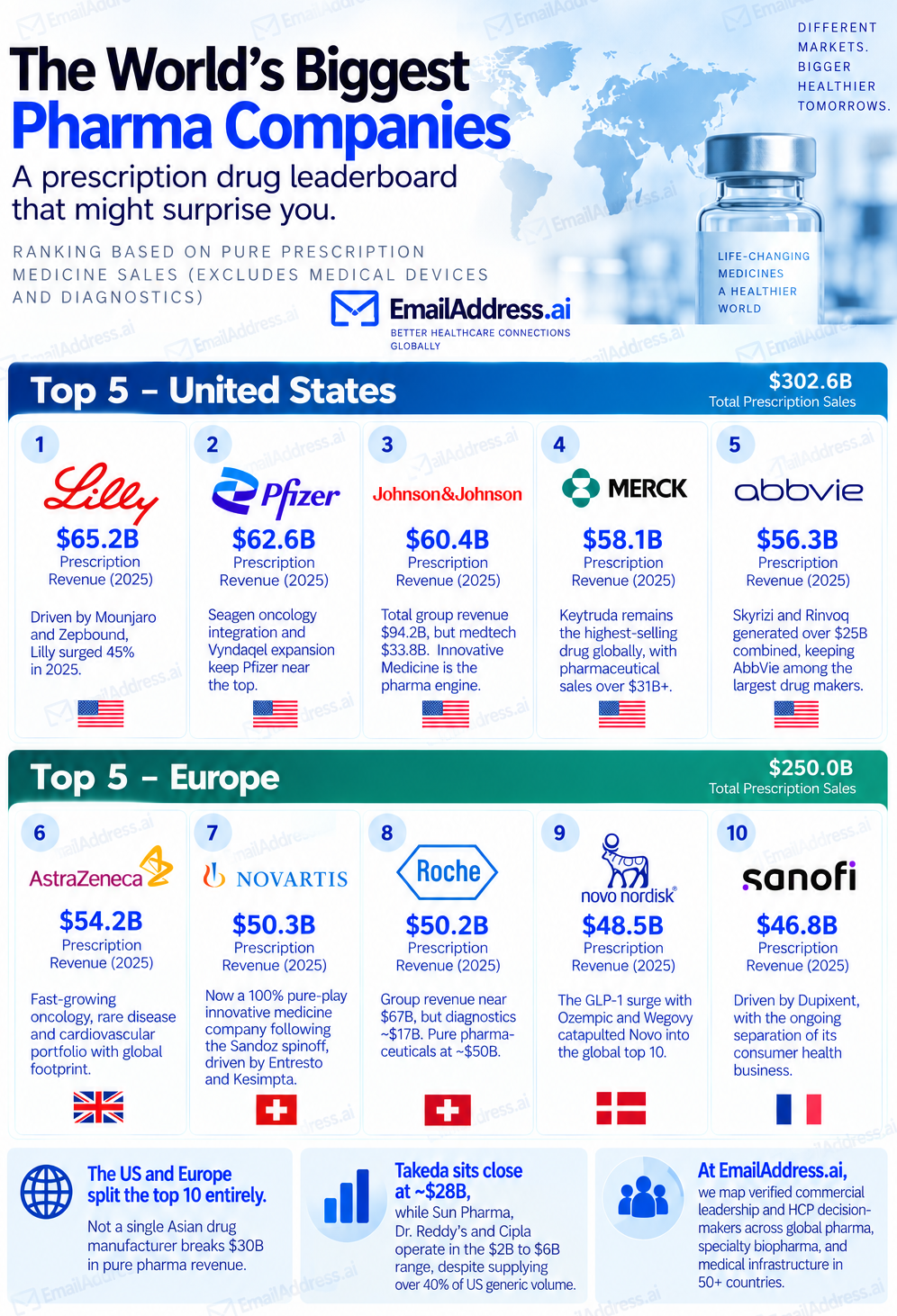
The World's Biggest Pharma Companies: A Geographic Reality Check for HCP Data Buyers
The top 20 pharmaceutical companies by revenue are concentrated in just three regions: the United States, Western Europe, and Japan. Six of the ten largest pharma manufacturers are American, four are European, and Asia remains underrepresented despite supplying 40% of US generic drugs. For anyone buying or licensing HCP data, this geographic concentration determines everything from compliance frameworks to marketing approaches to which physician specialties matter most.
I pulled the latest revenue data and mapped it against what actually matters for healthcare marketers. The patterns here aren't obvious. And they directly affect how you should approach HCP data licensing across different markets.
Which Pharma Companies Actually Dominate Global Revenue?
Here's the full ranking based on 2024-2025 reported revenue. I've included headquarters location because that's where data regulations, compliance rules, and purchasing decisions originate.
| Rank | Company | Headquarters | 2024-2025 Revenue (USD) | Primary Therapeutic Focus |
|---|---|---|---|---|
| 1 | Johnson & Johnson | USA | $94.2B | Immunology, Oncology, MedTech |
| 2 | Roche | Switzerland | $76B | Oncology, Diagnostics |
| 3 | Eli Lilly | USA | $61B | Diabetes, Obesity, Neuroscience |
| 4 | Pfizer | USA | $60B | Vaccines, Oncology, Internal Medicine |
| 5 | AbbVie | USA | $59B | Immunology, Oncology, Aesthetics |
| 6 | Merck & Co. | USA | $58B | Oncology, Vaccines, Hospital Acute Care |
| 7 | Novartis | Switzerland | $55B | Cardiovascular, Immunology, Oncology |
| 8 | AstraZeneca | UK | $55B | Oncology, Cardiovascular, Respiratory |
| 9 | Sanofi | France | $50B | Immunology, Vaccines, Rare Disease |
| 10 | Bristol Myers Squibb | USA | $48B | Oncology, Hematology, Cardiovascular |
| 11 | Novo Nordisk | Denmark | $48B | Diabetes, Obesity, Rare Blood Disorders |
| 12 | GSK | UK | $38B | Vaccines, Respiratory, HIV |
| 13 | Takeda | Japan | $29B | Oncology, GI, Rare Disease, Neuroscience |
| 14 | Gilead Sciences | USA | $28B | HIV, Oncology, Liver Disease |
| 15 | Amgen | USA | $27B | Oncology, Cardiovascular, Inflammation |
| 16 | Boehringer Ingelheim | Germany | $26B | Respiratory, Cardiovascular, CNS |
| 17 | Bayer (Pharma Division) | Germany | $19B | Oncology, Cardiovascular, Women's Health |
| 18 | Merck KGaA | Germany | $18B | Oncology, Neurology, Fertility |
| 19 | Sun Pharma | India | $6.2B | Generics, Specialty, OTC |
| 20 | Dr. Reddy's | India | $3.7B | Generics, Biosimilars, API |
According to IQVIA's 2025 Global Pharmaceutical Market Report, total global pharmaceutical spending reached $1.7 trillion in 2024. The companies in this table represent roughly 45% of that total.
Why Does Geographic Concentration Matter for HCP Data?
Data regulations follow headquarters, not sales territory. A US pharma company selling in Germany still operates under US corporate compliance. A German company selling in the US must navigate both GDPR at home and state-level privacy laws where they market.
This creates three distinct playbooks for HCP engagement:
US Companies: Data-Driven Marketing
American pharma operates in the most data-permissive major market. CMS Open Payments data is public. Prescription data is widely available. Email marketing to physicians faces fewer restrictions than in Europe. This means US-headquartered companies invest heavily in physician email data and digital targeting.
The practical implication: when you're selling HCP data to J&J, Pfizer, or Eli Lilly, they expect granular targeting capabilities. They want NPI-level data. They want prescribing behavior. They want email deliverability above 95%.
European Companies: Relationship-Driven Compliance
GDPR changed everything for Roche, Novartis, Sanofi, and AstraZeneca. These companies can't email physicians without explicit consent in most cases. They rely more heavily on field forces and medical science liaisons. When they buy HCP data, they prioritize verified consent status and audit trails.
If you're providing data to European pharma, expect longer procurement cycles. Expect legal review of every data source. Expect questions about exactly how physician information was collected.
Japanese Companies: Field Presence Priority
Takeda maintains one of the largest field forces per revenue dollar in the industry. Japan's pharma marketing culture still prioritizes in-person relationships over digital channels. This is slowly changing, but the preference remains.
For HCP data providers, this means Japanese pharma often wants territory mapping and call planning data more than email lists.
What Changed in 2025-2026 That Affects HCP Marketing?
Three shifts matter for anyone in the HCP data business:
Novo Nordisk's GLP-1 Dominance
Ozempic and Wegovy generated $15.7 billion in the first half of 2025 alone. This reshaped how endocrinologists, primary care physicians, and obesity medicine specialists are targeted globally. Suddenly, a Danish company became the most aggressive buyer of US endocrinology data.
The ripple effect: Eli Lilly's competing GLP-1 drugs pushed the company to $61B in revenue, up from $34B just two years prior. The diabetes and obesity space now commands more HCP marketing spend than any therapeutic area except oncology.
The Merck Confusion Gets Worse
Here's something that trips up data buyers constantly. Merck is two completely separate companies. Merck & Co. (US, $58B) and Merck KGaA (Germany, $18B) split during World War I. Different compliance frameworks. Different data rules. Different procurement systems.
If you're working on an HCP data providers comparison, you need separate entries for each. I've seen data deals fall apart because someone assumed "Merck" meant the same company in both contexts.
Indian Pharma's US Paradox
India's largest pharmaceutical companies remain under $7 billion in global revenue. But they supply 40% of generic drugs consumed in the United States. Aurobindo Pharma derives 89% of its revenue from exports. Sun Pharma and Dr. Reddy's generate 60-80% of revenue from US sales.
The paradox: your US physician data might be targeting their products without you knowing it. When a cardiologist prescribes generic atorvastatin, there's a good chance it was manufactured by an Indian company. The HCP engagement strategy for generics differs completely from branded drugs. Different physicians. Different touchpoints. Different data needs.
How Should This Affect Your HCP Data Strategy?
If you're buying or licensing healthcare contact data, here's the concrete takeaway:
Match your data investment to where decisions happen. The top 6 US pharma companies control over $380 billion in annual revenue and make most HCP data purchasing decisions from US headquarters. Your data quality, compliance documentation, and deliverability metrics will be evaluated against US standards first.
But if you're targeting European pharma, your consent documentation matters more than your list size. If you're working with Japanese companies, territory intelligence might matter more than email addresses.
For those running healthcare marketing campaigns, geographic alignment between your data and your client's compliance framework is the difference between a deal and a dead end.
What About Specialty Focus Areas?
Look at the therapeutic focus column in that table. Oncology appears 12 times. That's not an accident. Oncology drugs have higher margins, longer exclusivity periods, and more concentrated prescriber bases.
For HCP data, this means oncologist databases command premium pricing. The same physicians appear on target lists for AbbVie, BMS, Merck, Roche, Pfizer, AstraZeneca, and Novartis simultaneously. If your email verification process isn't catching duplicates and bounces, you're wasting budget on the most competitive specialty in pharma.
The second concentration: immunology and inflammation. AbbVie's Humira franchise, now facing biosimilar competition, reshaped how rheumatologists and dermatologists are targeted. J&J, Novartis, and Sanofi all compete in this space.
Third: diabetes and metabolic disease. Eli Lilly and Novo Nordisk's GLP-1 battle made endocrinologists and PCPs the most aggressively targeted physicians in 2025.
What's the Bottom Line for HCP Data Buyers?
The pharma industry looks global. But power concentrates in three regions with three different playbooks. Your data strategy should reflect where purchasing decisions happen, not just where products are sold.
If you're providing HCP data to pharma, know your buyer's headquarters. Know their compliance framework. Know whether they prioritize email deliverability or consent documentation or territory mapping.
The companies on this list spend billions annually reaching physicians. Your job is making sure your data matches their operating reality.
Frequently Asked Questions
Which country has the most top pharma companies by revenue?
The United States has 8 of the top 20 pharmaceutical companies by revenue, controlling over $455 billion in combined annual sales. This includes 6 of the top 10: Johnson & Johnson, Eli Lilly, Pfizer, AbbVie, Merck & Co., and Bristol Myers Squibb.
How big is India's pharmaceutical industry compared to US pharma?
India's two largest pharma companies, Sun Pharma ($6.2B) and Dr. Reddy's ($3.7B), have combined revenue under $10 billion. For comparison, Johnson & Johnson alone generates $94.2B. However, Indian manufacturers supply 40% of US generic drug volume, making them critical to the supply chain despite smaller revenue figures.
What percentage of global pharma revenue comes from the top 20 companies?
The top 20 pharmaceutical companies represent approximately 45% of the $1.7 trillion global pharmaceutical market, according to IQVIA's 2025 data. This concentration means HCP data buyers work with a relatively small number of major purchasers who set industry standards.
Why are there two different Merck pharma companies?
Merck & Co. (US, $58B revenue) and Merck KGaA (Germany, $18B revenue) split during World War I when the US government seized German-owned assets. They operate completely independently with different compliance frameworks, data rules, and procurement systems. Data providers must treat them as separate entities.
How much did GLP-1 drugs change pharma revenue rankings in 2025?
Novo Nordisk's GLP-1 drugs Ozempic and Wegovy generated $15.7 billion in H1 2025 alone, pushing the company into the top 11 globally. Eli Lilly's competing products helped grow that company from $34B to $61B in revenue within two years, moving it from outside the top 10 to the #3 position.
What therapeutic area has the most pharma company competition?
Oncology appears as a primary focus for 12 of the top 20 pharma companies, making it the most competitive therapeutic area. This concentration means oncologist email databases and contact data command premium pricing and face the highest verification demands.
How do data compliance requirements differ between US and European pharma companies?
US pharma companies operate in a more data-permissive environment and expect granular targeting with 95%+ email deliverability. European pharma companies subject to GDPR require verified consent documentation and audit trails for every physician contact, resulting in longer procurement cycles and more legal review of data sources.
By Gautam Mane, CEO EmailAddress.ai | LinkedIn | November 11, 2026