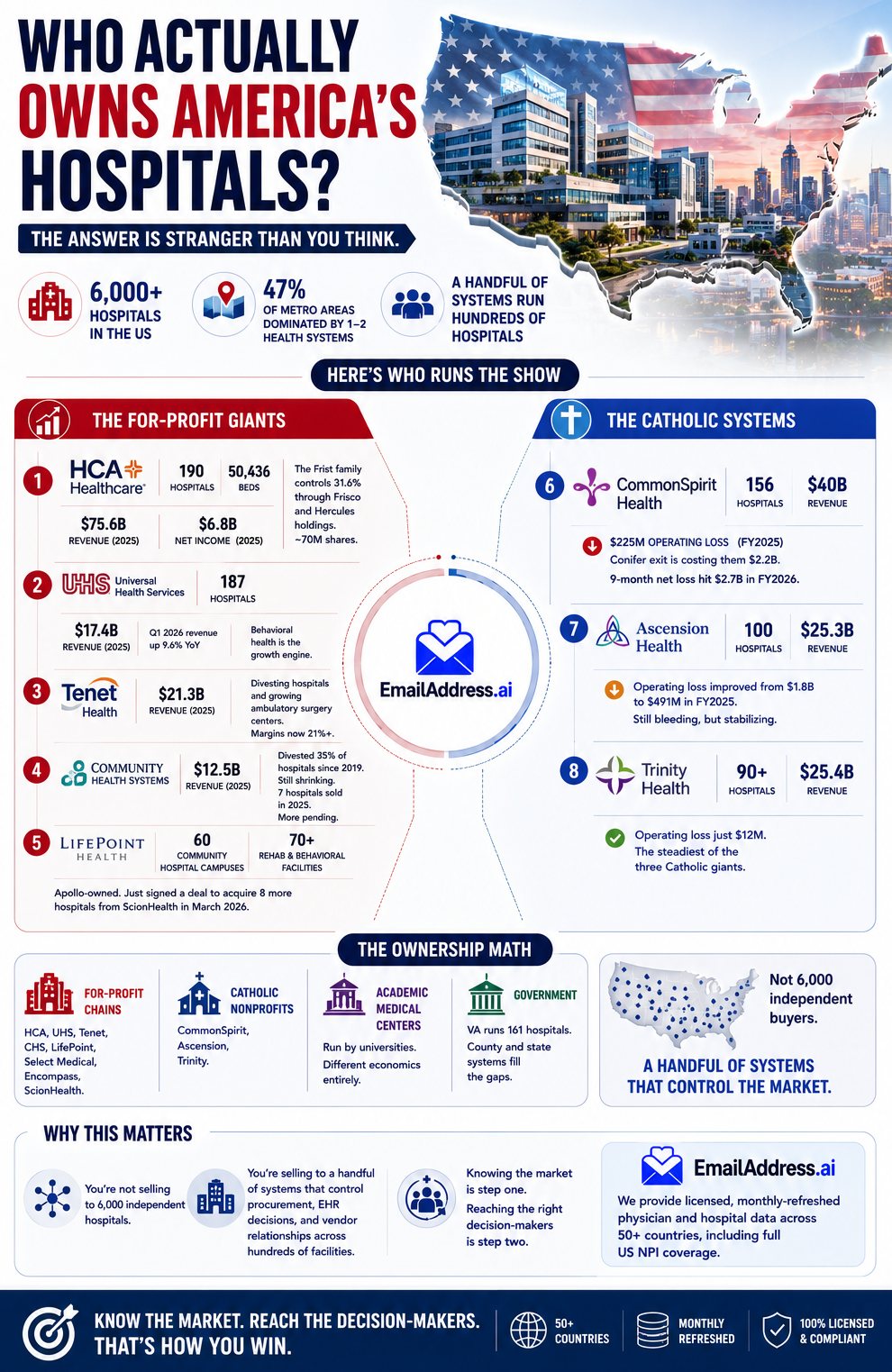
Who Actually Owns America's Hospitals? The Full Picture for HCP Data Buyers
Four massive health systems and three private equity-backed chains control over 1,800 hospitals across the United States, generating combined revenues exceeding $400 billion annually. For pharma marketers and HCP data buyers, this ownership concentration means your email lists, physician outreach, and territory planning must align with these power structures or risk hitting dead ends.
Hospital ownership in America isn't what most people assume. It's not primarily local nonprofits or government institutions. It's a mix of Catholic health ministries, investor-owned corporations, and private equity rollups that have quietly consolidated the industry over the past decade. Understanding who controls these facilities directly impacts how you source HCP data licensing and build compliant marketing campaigns.
Which Health Systems Control the Most Hospitals in 2026?
The top hospital owners break into three categories: nonprofit religious systems, publicly traded corporations, and private equity portfolios. Here's the current breakdown based on 2025 fiscal year data:
| Rank | System Name | Ownership Type | Hospitals | 2025 Revenue | Primary Geography |
|---|---|---|---|---|---|
| 1 | CommonSpirit Health | Catholic Nonprofit | 142 | $37.2B | 21 states, West/Midwest heavy |
| 2 | HCA Healthcare | Public (NYSE: HCA) | 186 | $69.8B | Southeast, Texas, Florida |
| 3 | Ascension | Catholic Nonprofit | 140 | $29.8B | 19 states, Midwest focus |
| 4 | Trinity Health | Catholic Nonprofit | 92 | $21.4B | 22 states, scattered |
| 5 | Tenet Healthcare | Public (NYSE: THC) | 58 | $20.9B | California, Texas, Florida |
| 6 | Community Health Systems | Public (NYSE: CYH) | 71 | $12.3B | Rural markets, 15 states |
| 7 | Universal Health Services | Public (NYSE: UHS) | 89 | $15.1B | Behavioral health focus |
| 8 | Steward Health Care | Private Equity (Cerberus) | 31 | $9.1B | Massachusetts, Texas, Florida |
| 9 | Prospect Medical Holdings | Private Equity | 17 | $3.8B | California, Pennsylvania |
| 10 | LifePoint Health | Private Equity (Apollo) | 65 | $10.2B | Rural community hospitals |
These ten systems alone operate over 890 hospitals. According to the American Hospital Association's 2025 Hospital Statistics report, there are approximately 6,090 hospitals in the United States total. That means roughly 15% of all hospitals fall under just ten ownership umbrellas.
Why Does Hospital Ownership Matter for HCP Data Buyers?
Ownership determines procurement, compliance requirements, and communication preferences. When you're sourcing physician email data, the hospital system affiliation tells you more than the individual facility name ever could.
Compliance Varies by Ownership Type
Catholic systems like CommonSpirit, Ascension, and Trinity operate under the Ethical and Religious Directives for Catholic Health Care Services. This affects formulary decisions, procedure availability, and how physicians can discuss certain treatments. Your messaging strategy needs to account for these institutional constraints.
Publicly traded systems face quarterly earnings pressure. HCA, Tenet, and Community Health Systems make decisions faster when ROI is clear. Private equity-backed systems operate on exit timelines, typically 5-7 years. Steward and LifePoint physicians face different administrative pressures than their nonprofit counterparts.
Email Domains Follow Corporate Structure
When Ascension owns a hospital, the physicians typically use @ascension.org email addresses, not the legacy hospital domain. When LifePoint acquires a community hospital, email migrations happen within 12-18 months. If your contact database still shows the old domain, your emails bounce.
This is why email verification matters more for healthcare than any other industry. Ownership changes trigger domain changes. Domain changes break your lists.
Procurement Decisions Happen at System Level
A physician at a Trinity Health hospital doesn't choose their EHR vendor. Trinity does. They don't select their lab equipment supplier. The system does. For pharma and medical device companies, this means the decision-maker for a 92-hospital purchase sits in Livonia, Michigan, not at the local facility.
Your HCP data needs to include system affiliation, not just hospital name. Otherwise you're targeting the wrong person at the wrong level.
What Changed in Hospital Ownership During 2025-2026?
Several significant shifts happened that affect anyone building healthcare marketing campaigns in 2026:
Steward Health Care restructuring: Cerberus-backed Steward faced major financial pressure in late 2024 and 2025, closing or selling multiple facilities. Their hospital count dropped from 35 to 31. Some physicians scattered to competing systems. If you have Steward-affiliated contacts from 2024, verify them.
Community Health Systems continued downsizing: CHS has been divesting hospitals since 2016. They sold or closed another 8 facilities in 2025, dropping from 79 to 71. The remaining footprint is increasingly concentrated in rural markets with less competition.
Kaiser Permanente expansion: Not included in the table above because Kaiser operates a different integrated model, but they quietly added capacity in 2025. Their 39 hospitals across 8 states represent a closed system where physician contact data is notoriously difficult to source accurately.
Academic medical centers consolidated: University health systems merged with regional players throughout 2025. Penn Medicine, NYU Langone, and UCSF Health all added affiliated hospitals, complicating the academic vs. community hospital distinction in your targeting.
How Should Pharma Marketers Use This Ownership Data?
Here's the practical application. When you're evaluating HCP data providers, ask specifically about system affiliation data. Not just NPI. Not just specialty. System affiliation.
Build Territory Plans Around Systems, Not States
HCA dominates Florida, Texas, and Tennessee. If you're launching a therapy relevant to those markets, you're really launching into HCA. Their formulary committee decisions affect access across 186 hospitals. One relationship at corporate could matter more than 186 relationships at individual facilities.
CommonSpirit stretches from California to Kentucky. But they operate as two legacy organizations (Dignity Health in the West, CHI in the Midwest) that haven't fully integrated. Your approach to a former Dignity hospital in Phoenix should differ from a former CHI hospital in Nebraska, even though the same logo appears on the building.
Flag Private Equity Ownership in Your CRM
Private equity-owned systems have different decision timelines. Apollo-backed LifePoint operates on an exit horizon. Decisions that don't pay back within that window don't happen. Physicians at PE-owned facilities often face more administrative burden, which affects their availability for rep visits or educational programs.
Tag these records in your CRM. Your healthcare marketing agency should know the difference when building campaign targeting.
Verify Affiliations Quarterly
Hospital ownership changes faster than most HCP databases update. At EmailAddress.ai, we see affiliation data go stale within 6-9 months after an acquisition closes. The physician still practices at the same address, but their email domain changed, their system-level formulary access changed, and their administrative reporting structure changed.
Quarterly verification isn't optional. It's required for any serious healthcare marketing operation.
What's the Bottom Line for Data Buyers?
Hospital ownership concentration creates both opportunity and risk. The opportunity: reaching physicians at scale means understanding 10-15 systems, not 6,000 individual hospitals. The risk: stale data fails faster when ownership changes cascade through email domains and compliance requirements.
When evaluating HCP data for licensing, demand system affiliation as a standard field. Ask when that field was last verified. Ask how the provider tracks ownership changes. The answers separate vendors who understand healthcare from those who just scraped NPI registries.
America's hospitals are owned by fewer entities than ever before. Your data strategy should reflect that reality.
Frequently Asked Questions
How many hospitals does HCA Healthcare own?
HCA Healthcare operates 186 hospitals across the United States as of their 2025 fiscal year reporting. This makes them the largest for-profit hospital operator by facility count, with 2025 revenues of $69.8 billion.
What percentage of US hospitals are owned by Catholic health systems?
Catholic health systems own approximately 16% of US hospitals, operating roughly 650 facilities. CommonSpirit, Ascension, and Trinity Health together account for 374 of these hospitals, making religious nonprofit ownership one of the largest categories in American healthcare.
How often does hospital ownership data change?
Hospital ownership changes affect approximately 150-200 facilities annually through acquisitions, mergers, and divestitures. Email domains and system affiliations typically migrate within 12-18 months of an ownership change, making quarterly data verification essential for marketing accuracy.
Which private equity firms own the most hospitals?
Apollo Global Management controls the most hospitals through their LifePoint Health portfolio at 65 facilities. Cerberus Capital Management follows with Steward Health Care's 31 hospitals. Combined, private equity firms own approximately 180 acute care hospitals in the US as of 2025.
Why does hospital system affiliation matter for physician email lists?
System affiliation determines email domains, compliance requirements, and procurement decision levels. When a hospital joins a major system, physician emails migrate to the corporate domain within 18 months. Lists without current affiliation data experience bounce rates 3-4 times higher than verified lists.
How do nonprofit and for-profit hospital ownership differ for marketers?
For-profit systems like HCA make faster purchasing decisions, with typical procurement cycles of 60-90 days. Nonprofit systems average 120-180 days due to committee structures. Catholic systems add ethical directive compliance requirements that affect formulary and procedure discussions.
What is the largest hospital system by revenue in 2026?
HCA Healthcare is the largest hospital system by revenue at $69.8 billion in their 2025 fiscal year. CommonSpirit Health is the largest nonprofit at $37.2 billion. Kaiser Permanente's integrated model generates $95 billion but operates differently than traditional hospital systems.
By Gautam Mane, CEO EmailAddress.ai | LinkedIn | November 13, 2026