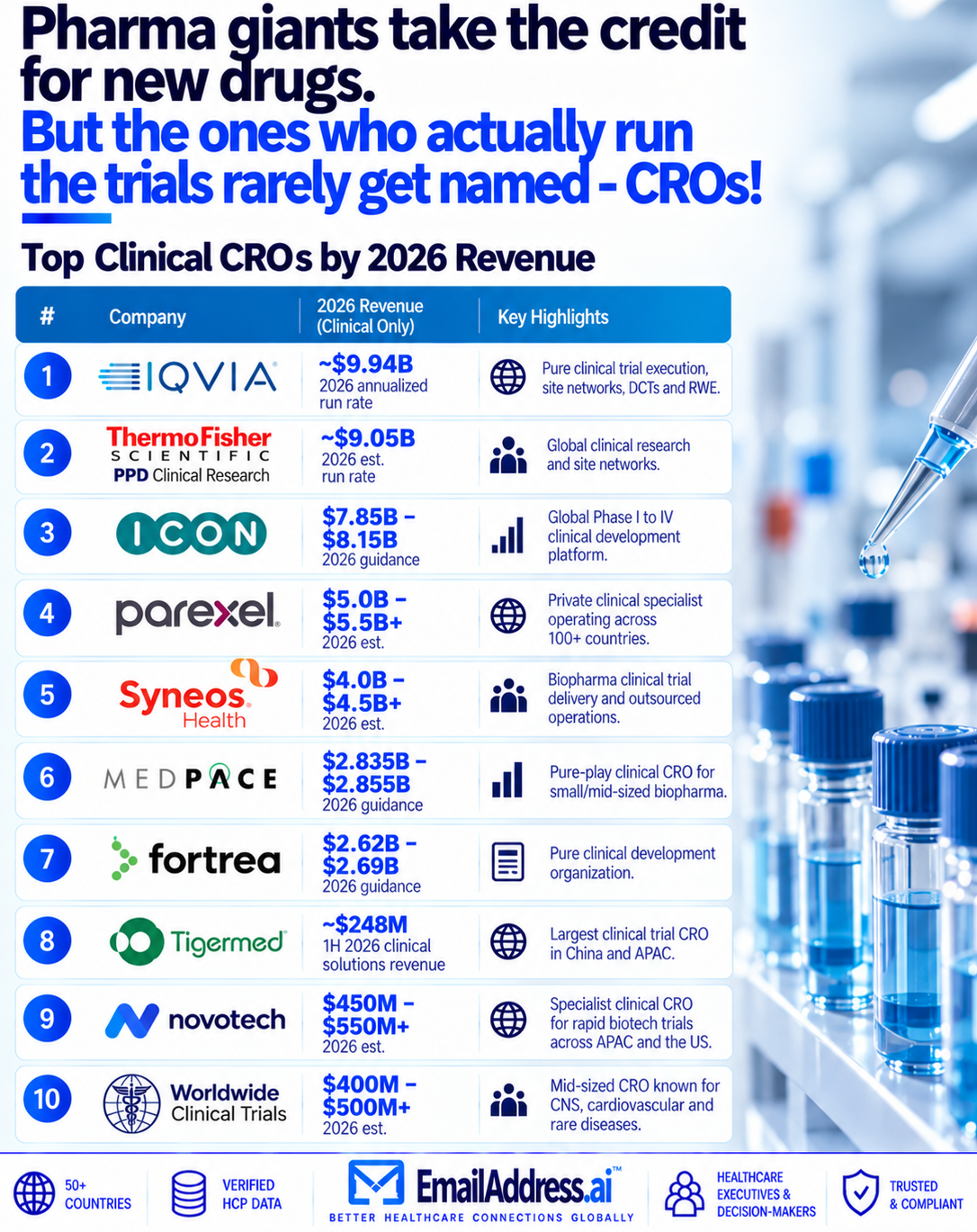
Top CROs in the Clinical Trials Market: Who Actually Runs Drug Development
The global contract research organization market is controlled by roughly 10 companies, with IQVIA, LabCorp Drug Development (Fortrea), and PPD (now Thermo Fisher) holding the largest shares. These CROs collectively manage over 60% of outsourced clinical trial activity worldwide, making them the operational backbone of modern drug development.
If you work in pharma marketing or buy HCP data for clinical recruitment campaigns, you need to know who these players are. Their investigator networks, site relationships, and geographic footprints directly determine which physicians participate in trials and how patient populations get accessed.
Who Are the Largest CROs by Revenue in 2025?
The CRO landscape consolidated heavily between 2020 and 2025. Several major acquisitions reshaped the top tier. Here's the current ranking based on 2024 fiscal year revenue and publicly available financial data:
| Rank | Company | 2024 Revenue (USD) | Headquarters | Ownership |
|---|---|---|---|---|
| 1 | IQVIA | $15.4 billion | Durham, NC (USA) | Public (NYSE: IQV) |
| 2 | PPD (Thermo Fisher) | $8.2 billion | Wilmington, NC (USA) | Subsidiary of Thermo Fisher |
| 3 | Fortrea (ex-LabCorp) | $7.6 billion | Durham, NC (USA) | Public (NASDAQ: FTRE) |
| 4 | ICON plc | $7.9 billion | Dublin, Ireland | Public (NASDAQ: ICLR) |
| 5 | Syneos Health | $5.3 billion | Morrisville, NC (USA) | Private (PE-owned since 2023) |
| 6 | Parexel | $3.1 billion | Durham, NC (USA) | Private (PE-owned) |
| 7 | Charles River Laboratories | $4.1 billion | Wilmington, MA (USA) | Public (NYSE: CRL) |
| 8 | Medpace | $2.1 billion | Cincinnati, OH (USA) | Public (NASDAQ: MEDP) |
| 9 | WuXi AppTec | $4.5 billion | Shanghai, China | Public (HKG: 2359) |
| 10 | Tigermed | $1.2 billion | Hangzhou, China | Public (SHE: 300347) |
Note: Charles River and WuXi AppTec generate significant revenue from preclinical services, so their clinical trial-specific revenue is lower than these topline figures suggest. The ranking reflects total company revenue where CRO services represent the majority of business operations.
Why Does North Carolina Dominate the CRO Industry?
Look at that headquarters column. IQVIA, PPD, Fortrea, Syneos, and Parexel all sit within a 30-mile radius in the Research Triangle region of North Carolina. This isn't coincidence.
The concentration started with Quintiles (now IQVIA) in the 1980s. As executives left to start competitors, they stayed local. The talent pool deepened. Universities like Duke and UNC-Chapel Hill feed the pipeline. Regulatory experience clusters in one geography.
For anyone buying HCP data licensing services, this matters. Many CROs share overlapping investigator databases and site networks. The same principal investigators appear in multiple CRO portfolios. When you're targeting physicians who participate in clinical trials, you're often reaching the same people regardless of which CRO runs the study.
What Changed in the CRO Market Between 2023 and 2025?
Three shifts reshaped the landscape:
1. Private equity moved in aggressively. Syneos Health went private in August 2023 through a $7.1 billion deal led by Elliott Investment Management and Patient Square Capital. Parexel was already PE-owned (EQT Partners and Goldman Sachs). This private ownership reduces public transparency around investigator networks and site performance data.
2. Fortrea spun off from LabCorp. In June 2023, LabCorp completed the separation of its drug development business into Fortrea. This created a pure-play CRO with roughly 19,000 employees and direct relationships with over 100 biopharma clients. Fortrea immediately became a top-5 CRO by revenue.
3. China-based CROs faced geopolitical headwinds. WuXi AppTec and Tigermed both grew rapidly in the early 2020s. But the BIOSECURE Act proposals in the U.S. Congress (2024-2025) created uncertainty around American pharma companies using Chinese CROs. Some sponsors began diversifying their CRO relationships as a result. According to GlobalData's 2024 pharmaceutical outsourcing report, Western sponsors reduced new China-based CRO contract awards by 18% year-over-year.
How Do CRO Investigator Networks Affect HCP Data Strategy?
CROs don't just run trials. They maintain proprietary databases of physicians who have served as investigators, sub-investigators, or site coordinators. IQVIA claims relationships with over 80,000 investigator sites globally. ICON, after acquiring PRA Health Sciences in 2021, operates in more than 100 countries.
These investigator networks overlap significantly with the physicians you might want to reach for commercial marketing, medical affairs, or KOL engagement. A cardiologist who served as an investigator on three heart failure trials is likely a strong target for peer-to-peer education programs or speaker bureaus.
The challenge: CROs guard their investigator data closely. They don't sell direct access to their networks. If you need physician email data for HCPs who participate in clinical research, you need a third-party provider who tracks investigator activity across ClinicalTrials.gov filings, publication authorship, and site disclosures.
What Should HCP Data Buyers Do About This?
Three practical steps:
- Filter by trial participation. When building targeting lists, look for data providers who append clinical trial flags to physician records. Not all do. This separates active investigators from general practitioners who never touch research.
- Track CRO announcements. Major CRO contract wins often name the therapeutic area and sometimes the phase. If Fortrea wins a Phase 3 oncology study, you can anticipate increased investigator recruitment in that space. Time your outreach accordingly.
- Verify before outreach. Investigator contact data goes stale fast. Physicians change institutions. Email addresses rotate. Use an email verification process before any clinical trial recruitment or investigator-targeted campaign.
Which CROs Have the Strongest Oncology and Rare Disease Capabilities?
Oncology represents roughly 35% of active clinical trials globally. Rare diseases have grown to represent over 20% of FDA drug approvals. These two areas now dominate CRO specialization.
Oncology leaders: IQVIA, PPD, and ICON all have dedicated oncology business units with hundreds of active trials. Medpace built its reputation on complex oncology protocols for mid-size biotech sponsors.
Rare disease specialists: ICON's acquisition of PRA strengthened its rare disease capabilities. Medpace and Worldwide Clinical Trials both emphasize rare disease as a differentiator against larger competitors. These firms maintain patient identification partnerships and advocacy group relationships that larger CROs often lack.
When you're comparing HCP data providers, ask specifically about investigator coverage in your therapeutic area. A provider might have strong primary care coverage but weak oncology depth. The CRO concentration in certain specialties should guide your data partner selection.
Why Does CRO Ownership Structure Matter for Pharma Marketers?
Public CROs disclose more. You can track their SEC filings for contract wins, regional expansion, and investigator network growth. IQVIA's 10-K filings reveal therapeutic area breakdowns. ICON's quarterly reports show backlog by geography.
Private CROs share less. Since Syneos went private, external visibility into their site network and commercial integration services dropped. Parexel publishes limited financial information.
This matters because CRO activity signals future HCP engagement opportunities. A CRO scaling up in a specific geography needs local investigators. A CRO expanding rare disease services needs specialist physicians. If you're running healthcare marketing campaigns targeting clinical trial activity, the public CROs give you a roadmap. The private ones require more inference.
What's the "So What" for Data Buyers?
Here's the concrete takeaway: CROs control access to the most research-active physicians in every major market. But they don't sell that access directly. They're not data vendors. They're operational partners to pharma sponsors.
If you need to reach investigators, clinical research coordinators, or site medical directors, you need data that tracks these roles independently. That means NPI-level records enriched with trial participation flags, publication history, and institutional affiliations.
At EmailAddress.ai, we build HCP datasets that identify physicians based on their research activity, not just their DEA license or specialty board certification. When you're targeting the HCPs who actually run drug development sites, that distinction matters.
Frequently Asked Questions
What is a CRO in clinical trials?
A contract research organization manages clinical trial operations on behalf of pharmaceutical and biotech sponsors. The top 10 CROs handle approximately 65% of outsourced clinical trial activity globally, according to GlobalData's 2024 market analysis.
Who is the largest CRO in the world?
IQVIA is the largest CRO by revenue, reporting $15.4 billion in 2024 fiscal year revenue. They operate in over 100 countries and maintain relationships with more than 80,000 investigator sites.
How many CROs are there globally?
The Association of Clinical Research Organizations estimates there are over 1,100 CROs worldwide. However, the top 10 companies control approximately 60% of total market revenue, with long-tail firms handling niche or regional work.
What percentage of clinical trials are outsourced to CROs?
Approximately 70% of clinical trial activities are now outsourced to CROs, up from roughly 55% a decade ago. Full-service outsourcing models grew 12% annually between 2020 and 2024.
Why are so many CROs headquartered in North Carolina?
The Research Triangle region hosts 5 of the top 10 CROs because Quintiles (now IQVIA) established there in 1982. Executive spinoffs, university talent pipelines from Duke and UNC, and accumulated regulatory expertise created a self-reinforcing cluster.
How do I find physician investigators for my marketing campaign?
Third-party HCP data providers track investigator activity by linking ClinicalTrials.gov filings to NPI records and institutional affiliations. This creates targetable lists of research-active physicians. Verify email addresses before outreach since investigator data has a 15-20% annual decay rate.
Are Chinese CROs reliable for Western pharma companies?
WuXi AppTec and Tigermed remain operationally capable, but geopolitical concerns reduced new Western contract awards by 18% in 2024. Sponsors increasingly maintain dual-CRO relationships to mitigate regulatory and supply chain risk.
By Gautam Mane, CEO EmailAddress.ai | LinkedIn | November 26, 2026