The Moment We Realized Verification Wasn't Enough
About four years ago, a pharma company came to us with a problem that didn't make sense on paper.
They'd run their prospect list through email verification. 5,000 addresses, all came back deliverable. Our verification was solid: 98% accuracy on mailbox detection. They deployed a campaign targeting marketing directors at enterprise healthcare companies.
But their response rate tanked. Not 5% lower. Not 10% lower. Down 30% compared to their historical average on similar campaigns.
They called back confused: "Your verification says the emails will deliver. They're delivering. But the person receiving them isn't the person we're trying to reach anymore."
That one conversation changed how we thought about the entire email verification category.
It turns out we were solving for the wrong problem.
The Hidden Cost of Stale Contact Data
Here's what that pharma team discovered: An email address that delivers today doesn't mean the contact is still relevant to your campaign.
Think about your own career. Average job tenure in the U.S. is two to three years. That means in any 5,000-person prospect list, somewhere between 1,000 and 1,500 people have changed jobs in the past two years. And you have no idea which ones.
So you verify 5,000 emails. All deliverable. You send your campaign. And 1,000 to 1,500 of those emails reach the wrong person entirely. Not bounces. Not spam issues. Just: wrong person, wrong context, wrong result.
That's not a verification problem anymore. That's a validation problem.
Standard email verification tools - even good ones - will never catch this because they only answer one question: "Will this email deliver?" They don't answer the question that matters: "Is this the person I'm trying to reach?"
The Math That Breaks Your Campaign ROI
Let's say you're running a B2B outreach campaign. Your baseline assumptions:
- 5,000 prospects on your list
- 3% reply rate from campaigns that hit the right person at the right time
- That's 150 replies, 30 meetings, 5-10 deals
But your list has a silent problem: 22.5% annual data decay. If you built this list even six months ago, roughly 560 to 675 of your 5,000 contacts have changed jobs, changed titles, or moved departments.
Now run the math with stale data:
- 5,000 verified deliverable addresses
- 4,325-4,440 reach the current employee (stale contacts were forwarded or bounced after 2-3 attempts)
- 1.5-2% reply rate from stale contacts (they're not in the role you're targeting, so they're less likely to care)
- 65-90 replies instead of 150
- 13-18 meetings instead of 30
- 2-4 deals instead of 5-10
Same verification quality. Different outcomes. The difference wasn't your message or your offer. It was that verification told you which mailboxes exist, not which people are still in the job you're trying to reach.
Why Catch-All Domains Made This Problem Even Worse
Healthcare is the perfect case study here because it hits this problem twice over.
Hospital domains are among the most common catch-all email systems in existence. Catch-all means the server accepts every address you send to it, whether that mailbox actually exists or not. A standard verification tool marks all of these as "valid" or "unknown" but can't distinguish whether the specific person you're targeting is actually using that address.
Add in the fact that physicians change hospital affiliations, retire, or shift practices at much higher rates than other professionals. And suddenly healthcare teams face something that looks impossible: verified lists with bounce rates hitting 5-9%.
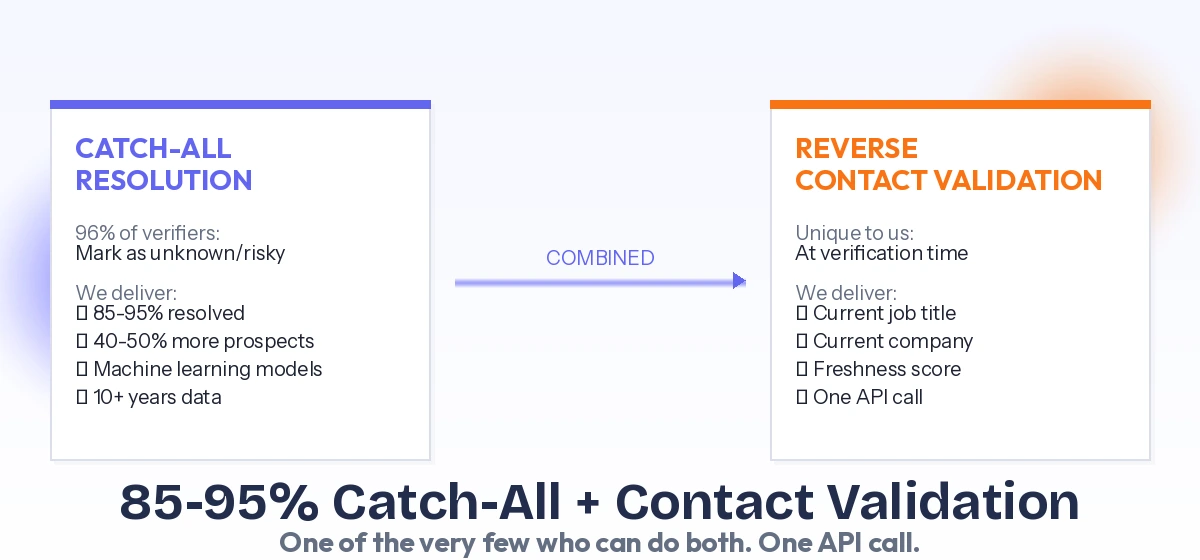
We solved the catch-all problem with Deep-SMTP technology. Here's why this matters: 96% of email verifiers fail at catch-all resolution. They just mark these addresses as "risky" or "unknown" and you lose 30-40% of your list. We cracked it: 85-95% resolution vs. competitors' 40-60%. We're one of the very few who can actually tell you which catch-all addresses will deliver.
But solving catch-all alone wasn't enough. We realized that a delivered email to a stale contact is still wasted email. So we integrated reverse contact lookup into the same verification call. One API call that returns both: "This address delivers AND this person is currently a marketing director at this hospital." Contact validation at verification time, simultaneously with verification.
That combination: catch-all resolution plus reverse contact validation in one call. Nobody else does both.
The Insight: Verification Is Just the Beginning
Around the same time this pharma company was calling us with their campaign troubles, we were starting to see a pattern across all our customers.
SDRs would complain: "The emails deliver, but half my calls reach people who don't remember the context of my message." Agencies managing millions of contacts would say: "We're verifying faster than ever, but our client campaigns are underperforming." Pharma teams would ask: "Why is our verified HCP list not converting the way it did last quarter?"
The answer was always the same: Deliverability isn't conversion. Verification isn't validation.
An email can be technically perfect and still be strategically irrelevant if it reaches someone who isn't in the buying role anymore. We kept hearing this feedback from teams across growth, revenue operations, and sales. The pattern was undeniable.
That's when we made a strategic decision: We'd build reverse contact lookup directly into the verification engine. Not as a separate tool. Not as an optional add-on. But baked into the same API call, the same request, the same moment you verify the mailbox.
How Reverse Contact Lookup Changes Everything
Here's what we built: When you verify an email address with EmailAddress.ai, we simultaneously validate the person behind it.
One API call returns:
- Email deliverability: Will this mailbox accept mail? (98% accuracy, 85-95% on catch-all domains)
- Identity validation: Is this email tied to a real person? (matched against 43 verified global data sources with 99.3% enrichment accuracy)
- Current role: What's their job title right now? (updated from the most recent sources available)
- Current company: Are they still at the company listed in your record? (cross-referenced in real time)
- Data freshness score: How recent is this information? (0-100 confidence score tells you exactly how current the contact validation is)
That pharma company could have run their 5,000-person list through this same engine and seen immediately: "1,247 of these addresses are stale. The people are still deliverable, but they've changed roles or companies in the past 12 months."
They could have excluded those 1,247 from the outreach, or flagged them for manual research, or run a lower-velocity sequence because the contact validation score was lower. Instead of a 30% response rate decline, they'd have maintained their baseline performance on the 3,753 current contacts.
Why This Matters at Scale: Agencies, Pharma, and Healthcare Systems
The reason 2,000+ customers now use this approach isn't philosophical. It's pure business math.
For Digital Agencies and Demand Gen Teams
An agency managing prospect lists for 50+ clients doesn't have time to manually validate every contact's current role. But they're being paid to deliver qualified leads, not valid mailboxes. When they bulk-verify lists and discover 25-30% stale rates, they now have a choice: refresh the data upstream, flag the stale contacts in the deliverable, or segment them into a lower-velocity nurture sequence.
Every one of these choices is better than sending to stale contacts and explaining to the client why the list underperformed. When agencies add contact validation to their verification workflow, they can guarantee that deliverability and relevance are both true. That's a competitive edge agencies can market to clients.
For Pharma and HCP Teams
A pharma company running an HCP (healthcare professional) campaign knows that sending to the wrong doctor or the wrong hospital is campaign death. But standard verification doesn't distinguish between "this HCP is in the specialty we're targeting and still practicing there" versus "this HCP was in that specialty two years ago and we never updated the record."
Reverse contact lookup surfaces this immediately. You verify 10,000 oncologist emails. The system flags 2,000 as stale. You focus the spend on 8,000 current oncologists. Same budget, better outcomes. The difference in ROI is dramatic. Pharma teams using EmailAddress.ai's integrated verification and validation report higher response rates and lower cost-per-meeting on HCP campaigns.
For Healthcare Systems and Medtech Sales
Hospital buying committees change constantly. A hospital procurement contact you called last quarter might have been promoted, transferred, or left the organization entirely. When your sales team verifies email lists as part of their outreach hygiene, they now get back not just "deliverable," but "this contact is still in procurement at this hospital and has been there for 18 months" versus "deliverable, but they moved to cardiac surgery."
That's the difference between a qualified call and a courtesy transfer. It's the difference between a contact who remembers your last conversation and one who has no context at all.
Real Data: What We've Learned From 2,000+ Customers
After four years of building this way, here's what the data tells us:
On data decay: B2B contact lists decay at 22-25% annually. But that decay isn't evenly distributed. Sales, marketing, and procurement roles turn over fastest. If you're targeting decision-makers in those categories and you're not validating contact freshness, you're targeting ghost employees by month six. Healthcare is even faster due to physician mobility and practice changes.
On catch-all handling (the differentiator 96% of competitors miss): Most email verifiers mark 40-60% of catch-all domains as "unknown" or "risky." You lose a third of your list. We resolve 85-95% of those with machine learning models trained on 10+ years of SMTP data. We can tell you which catch-all addresses are actually monitored inboxes versus dead-letter destinations. That's the first layer. The contact validation layer then tells you whether the person behind the email has changed roles. Together: catch-all resolution plus contact freshness. One API call. Competitors require two tools and you still lose the validation layer.
On conversion impact: Teams using reverse contact validation alongside verification maintain 2-3x better response rates than teams using verification alone, all else equal. Not because our verification is better than competitors. But because they're targeting active employees in relevant roles, not stale records and job changes.
On healthcare specifically: Healthcare teams see the highest bounce rates in B2B (averaging 5.9%) because of catch-all institutional domains and high physician mobility. Standard verifiers mark most hospital email as "unknown" and you lose 30-40% of your list before you ever send. We resolve 85-95% of those catch-all hospital domains. Then we layer in contact validation: you discover that 18% of your HCP list had role changes in the past 12 months. Segment them out, focus spend on current specialists. One pharma client running campaigns to 50,000+ HCP contacts improved response rates 2.3x by doing this. When teams combine catch-all resolution with contact validation, bounce rates drop to 1-2%. Healthcare email campaigns become predictable and scalable.
On cost-per-meeting: The real metric that matters to sales and marketing leaders. Teams implementing contact validation see 30-40% improvements in cost-per-meeting because they're eliminating budget waste on stale contacts. That improvement compounds over a full campaign cycle. One mid-market agency reported reducing cost-per-meeting from $520 to $310 after implementing contact validation alongside verification. Over a year of campaigns, that's six-figure savings.
What Changed for Our Customers: Real Examples
Here's what changed when customers added contact validation to their verification workflow.
Growth team at B2B SaaS company: Running 100K email campaigns monthly. After implementing contact validation, they discovered that 28% of their "verified deliverable" list had stale contact data. They segmented campaigns: fresh contacts got aggressive cadence (3 emails in 5 days), stale contacts got soft nurture (1 email every 2 weeks). Result: response rate on fresh segment jumped 52%. Stale segment still converted at 0.8% but without damaging sender reputation. They recovered an entire revenue stream they'd abandoned as "unprofitable."
Pharma commercial team: Running HCP campaigns across 15 specialty groups. Contact validation surfaced that pediatric neurologists had 34% stale rates (high turnover specialty), while pathologists had only 6% (more stable). They adjusted their spending: double budget on pathologists, halved on pediatric neuro until they could refresh that dataset. Campaign ROI improved 67% in Q2. The data-driven segmentation turned a problem into a strategic advantage.
Enterprise agency: Managing lists for 40+ enterprise clients. One client complained their "verified" list delivered 8% bounce rate on actual send, destroying their sender reputation. Investigation revealed contact validation would have caught this: 34% of the list had job changes. The client's in-house team just kept hitting send without validating contact freshness. Now the agency includes contact validation in their service agreement. They can guarantee both deliverability and contact relevance. That's a differentiator no competitor in their region offers.
These aren't outliers. They're typical. The pattern repeats: teams discover that verification alone leaves money on the table, but contact validation closes that gap.
Before reverse contact lookup: Verify list > Send campaign > Monitor bounces > Debug why response rates are lower than expected > Discover stale contacts > Repeat cycle next quarter.
After reverse contact lookup: Verify list + validate contacts > See which addresses are fresh, which are stale > Segment send strategy by contact validation freshness score > Send confident your list is current > Better response rates from day one > Learn and iterate faster.
The second workflow eliminates an entire feedback loop. You don't discover problems after you've wasted budget. You know about them before you send. This changes how teams think about list quality and targeting. Instead of deploying and learning, they build intelligence into the process upfront.
That's not a nice-to-have feature. That's a fundamental shift in how outbound email should work in 2026.
Why We Didn't Just Tell People to Use Two Tools
Someone always asks this: "Can't we just verify with one tool and then enrich with a contact enrichment API?"
Technically, yes. But here's why that doesn't work:
Timing gap: Verification happens at point of send. Enrichment happens before that. The data drifts between the two steps. Someone verified as current at step one might have changed jobs by step two. The timing mismatch breaks the entire premise.
Confidence scores: When verification and contact validation are separate processes, you don't know how fresh the contact data actually is. Reverse lookup integrated with verification lets you know: "This contact was validated in real time against sources updated yesterday" versus "This contact was enriched three weeks ago." Freshness matters more than completeness for outbound campaigns.
Cost efficiency: Running two separate services costs more than one integrated service. We price this so that integrated contact validation costs nearly the same as verification alone. You get validation as a bonus, not a premium feature that eats into marketing budgets.
Workflow integration: Separate tools mean separate APIs, separate integrations, separate data flows into your CRM. Integrated validation means one call, one response, one trusted data stream. The operational simplicity matters at scale when you're processing hundreds of thousands of contacts monthly.
That's why 2,000+ teams built their workflows around this approach. It's not about having more data. It's about having the right data at the right time with the right confidence score.
The Real ROI: Not Higher Bounce Rates, But Better Conversion
Here's what matters at the end of the quarter:
Standard verification approach: "Your bounce rate is 1.2%, which is below industry benchmark."
Verification with contact validation: "Your response rate is 6% instead of 3.5% because you're targeting current employees in the roles you're looking for, not stale records. Your cost-per-meeting dropped from $400 to $240. Your campaign ROI improved 60%."
The second metric is the one your CFO cares about. Bounce rate is a technical metric. Cost-per-meeting is a revenue metric. When you move from solving for deliverability to solving for relevance, you move the needle on the metrics that actually matter for sales and marketing leadership.
That's the fundamental difference. Verification is a hygiene check. Contact validation is a strategic advantage. Teams that implement both see the difference in pipeline velocity, deal size, and sales cycle length.
What This Means for Your Next Campaign
If you're currently running outbound campaigns - whether email, cold calling, LinkedIn, or multi-touch sequences - you're probably experiencing the silent cost of stale contact data.
You're seeing:
- Response rates lower than your benchmarks for no obvious reason
- High deliverability but lower engagement
- Calls that reach people who don't remember context
- Verified lists that somehow still underperform
- Budget waste on contacts who changed jobs months ago
That's not a message problem. That's not a timing problem. That's a targeting problem. And standard verification can't solve it because it's not designed to answer the question you actually need answered: "Is this person still in the role I'm trying to reach?"
Contact validation solves that. Not after you send. Before you send. During the verification process itself. That's the difference between hoping your list converts and knowing your list converts.
One More Thing: This Exists Because Real Customers Demanded It
We didn't wake up one day and think, "Let's add reverse lookup to verification for fun."
We built it because 2,000+ teams across growth marketing, sales operations, pharma commercial, and healthcare told us the same thing: "Verification helps, but it's only half the battle."
That feedback loop is how EmailAddress.ai developed. We listen to what breaks in real campaigns, we solve it, and we build it into the platform rather than telling customers to stitch together three different vendors.
That's the difference between a point solution and a platform. A point solution does one thing well. A platform solves the entire workflow. And it's why teams keep using us. Because we solved the problem they actually have, not the problem we thought they had.
The teams that stick with us are the ones that discovered: verification alone wasn't enough. Contact validation changed their numbers.
Ready to Verify and Validate at Once?
Get 100 free email verifications with real-time contact validation included. See exactly which contacts are current employees and which are stale records. No card required.
Start Free Trial | Book a Demo
Join the 2,000+ teams using verified email with contact validation. Improve your cost-per-meeting. Maintain predictable campaign ROI. Stop wasting budget on stale contacts.
Key Sources
- Cleanlist: Email Deliverability Benchmarks 2026
- Bouncify: Why Your Email Bounce Rate Is High in 2026
- MyEmailVerifier: Email Bounce Rate by Industry 2026
- EmailAddress.ai Internal Dataset: 200M+ Records Processed (2025-2026)
- RocketReach: How B2B Data Accuracy Impacts Revenue - 2026 Analysis
- Salesmotion: Complete Guide to B2B Contact Data Quality