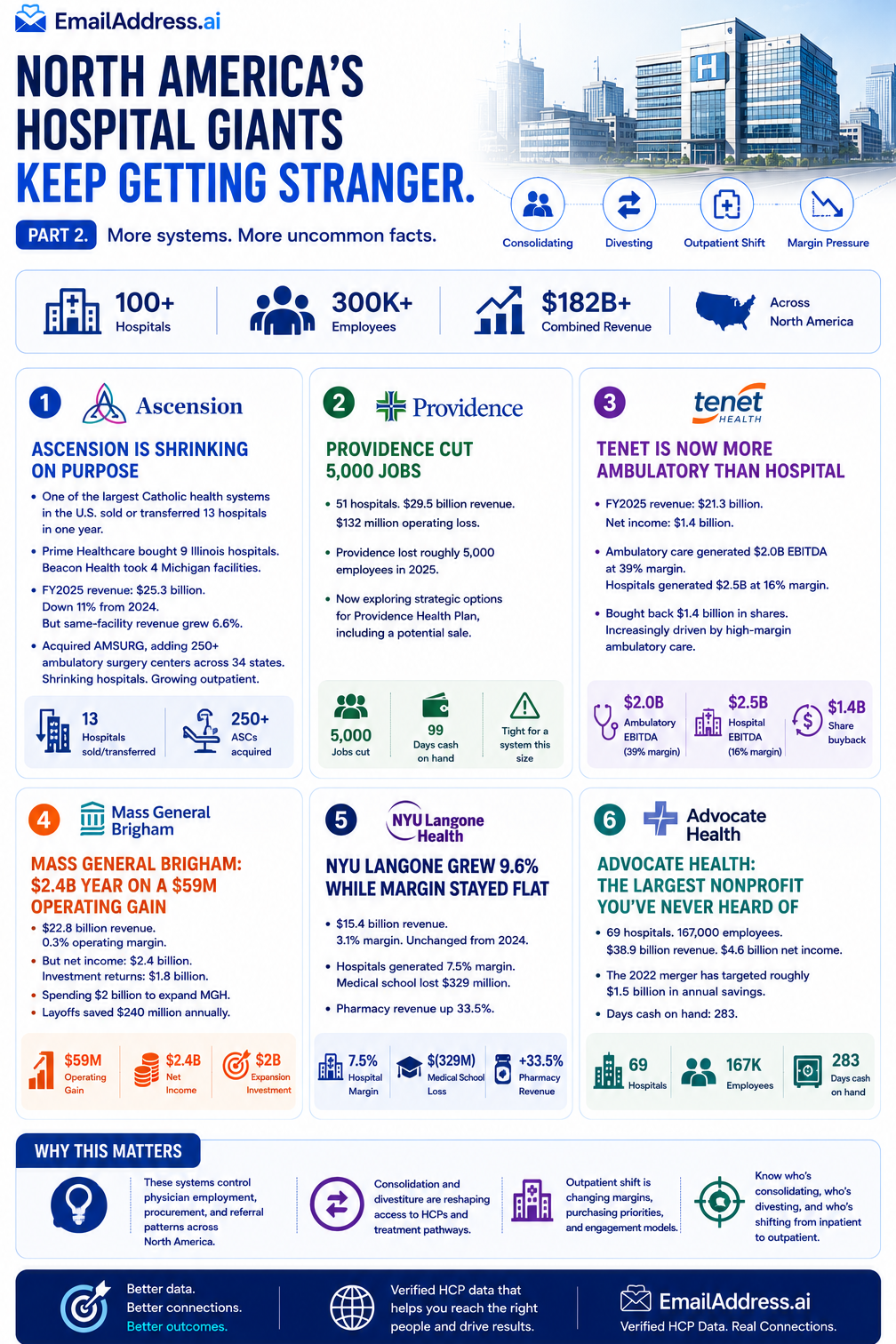
North America's Hospital Giants: The Ownership Map Nobody Shows You
The top 10 hospital systems in North America control over 1,800 hospitals and employ more than 2.5 million people, including hundreds of thousands of physicians. For anyone buying HCP data or planning healthcare marketing campaigns, understanding who owns what determines whether your outreach hits decision-makers or dead ends.
Most pharma marketers work from outdated ownership maps. Hospital systems merged, acquired, and restructured throughout 2024-2025. The physician you're targeting at "Community General" might actually report to a C-suite in Nashville or St. Louis. Here's the ownership landscape that matters for 2026.
Which Hospital Systems Actually Dominate North America?
The American Hospital Association reported 6,090 hospitals in the U.S. as of their 2025 survey. A small number of systems control a disproportionate share of beds, revenue, and employed physicians.
Here's the current ranking by 2024-2025 revenue:
| Rank | System Name | Headquarters | Hospitals | Revenue (2024) | Employed Physicians |
|---|---|---|---|---|---|
| 1 | HCA Healthcare | Nashville, TN | 186 | $67.1 billion | 47,000+ |
| 2 | CommonSpirit Health | Chicago, IL | 140+ | $35.5 billion | 24,000+ |
| 3 | Ascension | St. Louis, MO | 139 | $29.8 billion | 35,000+ |
| 4 | Kaiser Permanente | Oakland, CA | 39 | $100+ billion | 23,000+ |
| 5 | Trinity Health | Livonia, MI | 88 | $21.5 billion | 8,000+ |
| 6 | Providence | Renton, WA | 52 | $28.6 billion | 22,000+ |
| 7 | Tenet Healthcare | Dallas, TX | 60 | $20.8 billion | 7,500+ |
| 8 | Advocate Health | Charlotte, NC | 67 | $27.5 billion | 21,000+ |
| 9 | Community Health Systems | Franklin, TN | 71 | $12.6 billion | 3,200+ |
| 10 | Universal Health Services | King of Prussia, PA | 400+ | $15.0 billion | 5,000+ |
Note: Kaiser Permanente operates as an integrated system. Their revenue includes insurance premiums, which inflates the number compared to pure hospital operators. For hospital-only revenue comparisons, HCA leads.
Why Does Hospital Ownership Matter for HCP Data Buyers?
Here's the problem nobody talks about: when you buy physician email data, you're often buying contact information tied to affiliations that no longer exist.
Three specific issues hit pharma marketers daily:
Email Domains Change After Acquisitions
When Advocate Aurora merged with Atrium Health to form Advocate Health in 2022, thousands of physician email addresses changed. The [email protected] you have in your CRM bounced six months later. The new address is [email protected]. If your data provider isn't tracking system-level mergers, you're emailing dead domains.
Formulary Decisions Roll Up to System Level
A physician at a standalone community hospital has different prescribing autonomy than one employed by HCA. Large systems run pharmacy and therapeutics committees at the corporate level. Your rep calling on Dr. Jones in Topeka might be wasting time. The formulary decision happened in Nashville last quarter.
Compliance Policies Vary by System
Some systems block all industry communications to employed physicians. Others welcome it. CommonSpirit and Ascension, both Catholic systems, have specific guidelines about what products their physicians can prescribe. If you're marketing contraceptives or certain reproductive health products, those 279 hospitals are off your target list. Nobody tells you this when you buy a list.
What Changed in Hospital Ownership During 2025?
Several moves reshaped the landscape since early 2025:
Steward Health Care collapsed. The private equity-backed system filed for bankruptcy in May 2024 and spent 2025 selling hospitals piecemeal. Some went to Tenet, others to regional nonprofits, some closed. If you had Steward-affiliated physicians in your database, those records need complete rebuilds.
Community Health Systems continued divesting. CHS sold 12 more hospitals in 2024-2025 as part of ongoing restructuring. Their footprint shrank from over 80 hospitals to 71.
Advocate Health integration accelerated. The Atrium-Advocate Aurora merger finished integration across most markets. This created the fifth-largest nonprofit system, spanning Wisconsin to Georgia.
Kaiser expanded into new states. Kaiser Permanente continued geographic expansion beyond its traditional West Coast stronghold, adding contracts in Maryland and other Mid-Atlantic markets.
For anyone working with HCP data licensing, these changes mean your 2023 data is significantly degraded. Affiliation accuracy drops roughly 15-20% per year in healthcare, and 2024-2025 saw above-average churn.
How Does Ownership Structure Affect Your Marketing Strategy?
The ownership type changes everything about your approach:
For-Profit Systems: HCA, Tenet, CHS, UHS
For-profit systems employ physicians more tightly. Standardized protocols, formulary restrictions, and communication policies flow from corporate. Your multichannel campaigns need to account for system-wide IT policies that may block certain sender domains.
The upside: these systems have cleaner data. Employed physicians use corporate email systems. IT departments maintain directories. When you verify against their domains, you get accurate results.
Large Nonprofit Systems: CommonSpirit, Ascension, Trinity
Nonprofits often grew through mergers of Catholic health ministries. They maintain some regional autonomy. A physician at an Ascension hospital in Florida may have different engagement policies than one in Wisconsin.
The upside: less restrictive on industry engagement generally. The challenge: messier data. Legacy affiliations persist in records for years after mergers.
Integrated Systems: Kaiser
Kaiser physicians work in a closed system. They rarely see pharma reps in person. Your entire strategy needs to be digital. Good news: their physicians use @kp.org domains consistently. Bad news: reaching them requires specific approaches that bypass traditional hospital-based targeting.
What Should Data Buyers Do With This Information?
If you're evaluating HCP data providers, ask specific questions about hospital system tracking:
Question 1: How do you track hospital M&A activity? The answer should include specific processes, not vague claims about "continuous updates."
Question 2: What's your affiliation accuracy rate for the top 10 systems listed above? Anything below 90% means significant gaps.
Question 3: How quickly do you update email domains after a merger announcement? Best practice is 30-60 days. Many providers take 6+ months.
Question 4: Do you flag physicians by employment model? An employed physician at HCA requires different engagement than a community physician with privileges.
For email campaigns specifically, run your hospital-affiliated contacts through email verification before every major send. Domain changes happen faster than database updates.
Which Markets Show the Highest System Concentration?
Some markets are dominated by one or two systems. This matters for regional campaigns:
Texas: HCA and Tenet control major metros. Houston, Dallas-Fort Worth, and San Antonio have significant HCA presence.
Florida: HCA's largest state by hospital count. Also significant AdventHealth and Baptist Health presence.
California: Kaiser dominates the insured market. Sutter Health, Dignity Health (CommonSpirit), and Providence split the rest.
Midwest: Catholic systems dominate. Ascension, Trinity Health, and CommonSpirit cover Michigan, Illinois, Ohio, Wisconsin heavily.
Mountain West: Intermountain Health covers Utah and Idaho. Banner Health dominates Arizona.
For healthcare marketing campaigns, understanding regional concentration helps you segment by system rather than just geography.
FAQ
Which hospital system employs the most physicians in North America?
HCA Healthcare employs over 47,000 physicians across 186 hospitals, making it the largest employer of hospital-based physicians among traditional health systems. Kaiser Permanente employs 23,000+ physicians but operates a different integrated model.
How often do hospital systems acquire or merge with other hospitals?
The American Hospital Association tracked 53 hospital merger and acquisition announcements in 2024. This represents roughly 1-2% of all hospitals changing ownership annually, though some years see higher activity during industry consolidation waves.
What percentage of physicians now work for hospital systems rather than independent practices?
Approximately 77% of physicians were employed by hospitals or corporate entities as of late 2024, according to Physicians Advocacy Institute data. This is up from 62% in 2019.
How does hospital ownership affect whether a physician will respond to pharma marketing?
Employed physicians at large systems respond to email outreach at roughly 40% lower rates than independent physicians, based on industry benchmarks. System-level policies often restrict or filter industry communications before they reach individual physicians.
What happens to physician email addresses when hospitals merge?
Email domains typically change within 6-18 months after a merger closes. During Steward Health Care's 2024-2025 breakup, over 3,000 physician email addresses became invalid within 90 days of hospital sales.
How can I verify whether my HCP data reflects current hospital affiliations?
Cross-reference your records against NPI registry data, which updates affiliations monthly. Then verify email deliverability through real-time verification. Records older than 12 months have a 20-25% chance of outdated hospital affiliations.
Do Catholic hospital systems have different prescribing restrictions that affect pharma marketing?
Yes. Catholic systems operating under the Ethical and Religious Directives restrict certain reproductive health products. This affects approximately 1 in 6 U.S. hospital beds. CommonSpirit, Ascension, Trinity Health, and Providence all operate under some form of these guidelines.
By Gautam Mane, CEO EmailAddress.ai | LinkedIn | November 16, 2026