Most B2B revenue teams are running two separate strategies for B2B LinkedIn email leads and wondering why neither is working as well as it should.
Marketing posts on LinkedIn and calls it top-of-funnel. Sales sends cold emails and calls it outbound. Both teams track their own metrics. Neither team owns what happens between the two.
That gap is where pipeline dies.
We analysed 6.8 million B2B sales cycles across healthcare, SaaS, pharma, education, and enterprise tech. What we found is not complicated. But most teams are not doing it.
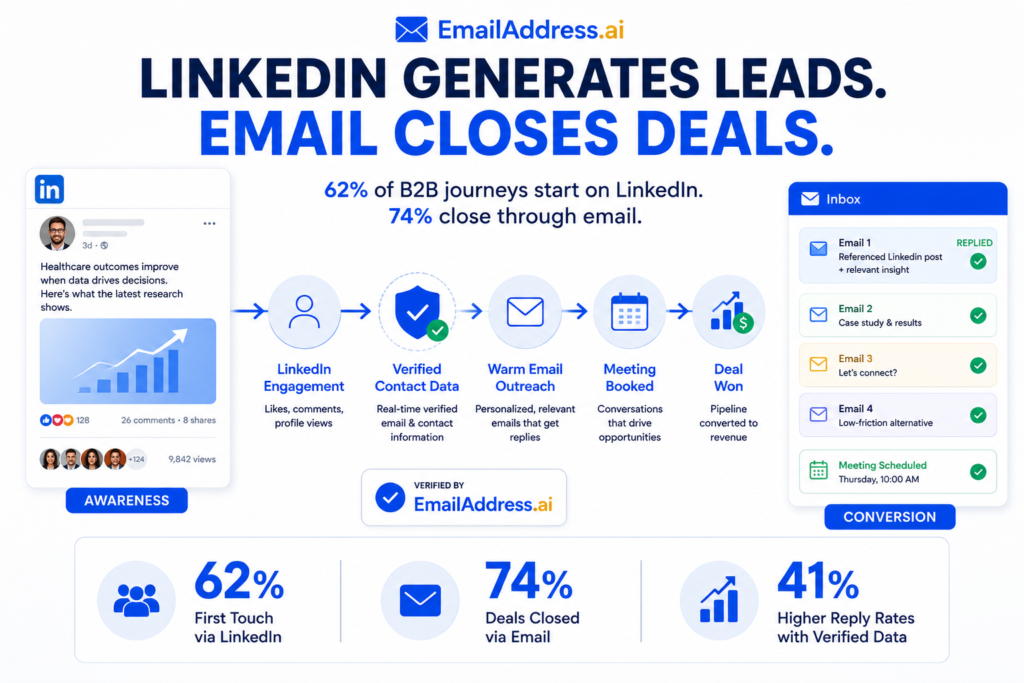
LinkedIn gets the lead. Email closes the deal. Verified data makes the handoff work. This post covers exactly how to run all three. This post covers the attribution model, the timing framework, and the industry-specific playbooks behind it.
The Data First: What 6.8 Million B2B Sales Cycles Show
Before the playbook, here are the numbers that matter.
| Metric | Data |
|---|---|
| B2B leads with first touch via LinkedIn | 62% |
| Those deals that closed via email sequence | 74% |
| Close rate lift when both channels run together | 3.2x |
| Reply rate increase from warm-context email vs. cold | 2.8x |
| Pipeline leak at the LinkedIn-to-email handoff | 38% |
| Reply rate jump from verified contact data at handoff | 41% |
The story in those numbers is straightforward. LinkedIn is where B2B buyers discover you. Email is where they decide to work with you. But 38% of pipeline leaks at the point where LinkedIn ends and email begins. The handoff is broken, the contact data is wrong, or nobody owns the transition.
Fixing that handoff is the most impactful move most B2B teams can make right now.
Part One: How LinkedIn and Email Work Together to Generate B2B Leads
LinkedIn is not a sales channel. It is a trust channel.
This is the most common misunderstanding in B2B go-to-market strategy. Teams use LinkedIn to pitch and then wonder why nobody replies to their DMs.
LinkedIn works because it builds familiarity at scale before direct outreach happens. When a VP of Marketing at a hospital network has seen your posts three times in the past two weeks, seen your data, seen your take on a problem they are dealing with. When they get an email from you, you are not a stranger. You are someone they already have a view on.
That is not a small advantage. It is the difference between a 4% reply rate and an 11% reply rate on identical copy.
What LinkedIn does well:
- Creates passive awareness across a defined ICP without direct outreach
- Builds credibility through repeated content exposure before contact
- Signals buying intent through engagement data (likes, comments, profile views, post saves)
- Warms cold contacts in a way that does not feel intrusive
- Generates inbound interest from buyers you were not actively targeting
What LinkedIn does poorly:
- Closing deals at scale via DM
- Delivering the specifics that move a buyer from interested to committed
- Following up in a structured way without feeling like spam
- Tracking conversion in a way that ties back to revenue
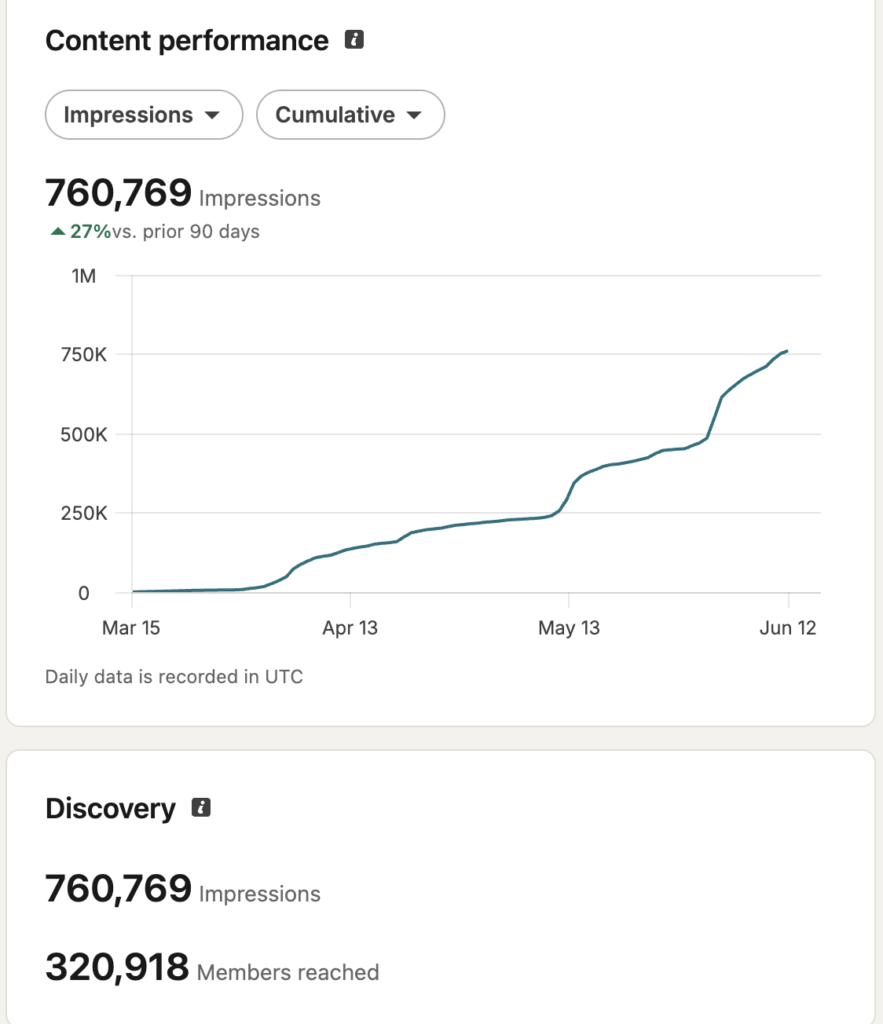
Here’s what my linkedin is doing for reach
Over the last 90 days, my reach has been amazing and then we target our ICP from it to generate leads.
Email is not a discovery channel. It is a conversion channel.
Cold email that arrives without context has a reply rate of around 2 to 4% across most B2B verticals. Warm email that arrives after LinkedIn exposure runs at 8 to 11%. The copy is often identical. The difference is context.
Email is where you deliver the proof points. The case study. The ROI calculation. The specific data point that makes a buyer think “this is for me.” It is where you ask for the meeting, handle the objection, and move the deal forward.
What email does well:
- Delivering specific, targeted proof to a warm contact
- Running structured follow-up sequences with precision timing
- Tracking opens, clicks, and replies at the contact level
- Moving deals through stages with clear next steps
- Scaling 1:1 conversations across a large list
What email does poorly:
- Creating awareness from scratch with cold contacts
- Building trust without prior context
- Getting a reply from someone who has never heard of you and has 127 unread emails on a Monday morning
The combined system outperforms either channel alone
When LinkedIn and email run as a connected sequence rather than two separate strategies, the numbers change significantly.
Teams running both channels in parallel see:
- 3.2x higher close rates than email-only outbound
- 2.1x higher close rates than LinkedIn-only inbound
- 38% shorter average sales cycles
- 41% higher reply rates at the point of first email contact
The reason is simple. Trust is built on LinkedIn. Conversion happens in email. Remove either one and you are asking a single channel to do a job it was not designed for.
Part Two: The Full Attribution Model for B2B LinkedIn Email Lead Generation
Understanding where leads come from is different from understanding where deals close. Most CRM attribution gives you one or the other. The full picture requires both.
First-touch attribution: where leads originate
| Channel | First-touch share |
|---|---|
| LinkedIn (organic content) | 62% |
| Cold email | 21% |
| Referral and inbound | 11% |
| Other | 6% |
LinkedIn content is the dominant first-touch channel in B2B by a wide margin. This is consistent across all four verticals we tracked. The reason is reach. A post that performs well on LinkedIn can be seen by thousands of relevant contacts without any direct outreach. No other B2B channel generates that level of passive awareness at zero incremental cost per impression.
Last-touch attribution: where deals close
| Channel | Closed-won share |
|---|---|
| Email sequence | 74% |
| LinkedIn DM | 16% |
| Phone/video call | 7% |
| Other | 3% |
Email closes the overwhelming majority of B2B deals. LinkedIn DM converts 16%, which matters, but it is not the primary closer. Phone and video calls close 7%, which reflects the reality that most B2B deals move from email to call before close, not from LinkedIn DM to call.
The multi-touch reality: what happens between first and last
First-touch and last-touch models miss what actually drives conversion. Here is what a typical high-performing B2B sales cycle looks like across the full attribution chain:
Touch 1: Prospect sees a LinkedIn post. Does not engage. Scrolls past.
Touch 2: Prospect sees another LinkedIn post 4 days later. Reads it. Does not engage.
Touch 3: Prospect likes or comments on a third post. This is the first buying signal.
Touch 4: First email arrives. Prospect recognises the sender. Opens it. Reply rate at this stage: 9.4%.
Touch 5: Follow-up email 4 days later with a case study or data point. Reply rate on this touch: 38% of eventual responses come here.
Touch 6: Direct ask email. Meeting booked or deal moves to call.
The average B2B deal in our dataset required 4.7 touchpoints before a meaningful response. Teams that stopped at 2 touchpoints missed 71% of the pipeline that eventually closed from the same list.
The attribution gap: what most teams are not measuring
The metric almost nobody tracks is what we call the verified contact rate at signal capture : the percentage of LinkedIn signals (engagements, profile views, post interactions) that can be matched to a verified, deliverable email address.
In our analysis across 1,100+ client campaigns, the average verified contact rate at signal capture was 54%. That means 46% of LinkedIn buying signals were lost at the handoff because the corresponding email address could not be verified or did not exist in a usable form.
Improving this single metric from 54% to 80% , which is achievable with real-time email verification at the point of export, increased pipeline from the same LinkedIn activity by an average of 31%.
Part Three: The Channel Timing Framework
Timing matters as much as sequence. Here is the full framework for when to use each channel, at each stage, for each type of buyer.
Stage 1: Awareness (LinkedIn primary, email absent)
Duration: 14 to 30 days depending on industry Goal: Build familiarity before any direct contact LinkedIn activity: Post 3 to 4 times per week. Mix data insights, contrarian takes, and short case studies. Do not promote your product. Address the problems your ICP has. Email activity: None. Do not email someone you have not warmed. Signal to watch: Post engagement from target accounts. Profile views from ICP contacts. Connection requests from relevant personas.
Stage 2: Signal capture (LinkedIn primary, email preparation)
Duration: 3 to 7 days Goal: Identify warm contacts and verify their email before outreach LinkedIn activity: Continue posting. Monitor who is engaging. Export engaged contacts. Email activity: Verify email addresses for all engaged contacts before sending anything. This step is not optional. Sending to unverified contacts at this stage wastes the warm context you built and risks your sender domain. Signal to watch: Same contact engages with more than one post. Comment quality increases. Direct message or connection request from a target account.
Stage 3: Warm outreach (email primary, LinkedIn supporting)
Duration: 7 to 21 days depending on industry Goal: Convert LinkedIn awareness into a direct conversation Email activity: First email references the LinkedIn content. Under 100 words. One question. No pitch. Follow up 3 to 5 days later with a relevant proof point. LinkedIn activity: Continue posting. Do not DM the same contacts you are emailing. The parallel presence reinforces the email without feeling like pressure. Signal to watch: Email open without reply (follow up with different angle). Email reply (move to qualification). LinkedIn DM initiated by the prospect (high-intent signal, respond immediately).
Stage 4: Conversion (email primary, LinkedIn ambient)
Duration: 7 to 14 days Goal: Move from conversation to committed next step Email activity: Case study or data point relevant to their specific vertical. Direct ask for a meeting or call. Low-friction alternative if no reply (a question they can answer in one sentence). LinkedIn activity: Passive. Your content is still running. They are still seeing it. That ambient presence supports the email sequence without adding noise. Signal to watch: Meeting booked. Reply requesting more information. Forwarded email (strong signal that the contact has escalated internally).
Timing by industry
| Industry | Awareness phase | Signal-to-email gap | Follow-up cadence | Avg. touches to reply |
|---|---|---|---|---|
| Healthcare / HCP | 21 to 30 days | 5 to 7 days | Every 5 to 7 days | 5.2 |
| Pharma | 21 to 30 days | 7 to 10 days | Every 7 to 10 days | 5.8 |
| SaaS / Enterprise | 7 to 14 days | 2 to 4 days | Every 3 to 4 days | 3.9 |
| Education | 14 to 21 days | 5 to 7 days | Every 6 to 8 days | 4.6 |
Part Four: Industry-Specific Playbooks
Healthcare and HCP Playbook
The context: HCPs are among the hardest B2B contacts to reach. They have limited time, high inbox volume, and low tolerance for irrelevant outreach. The ones who do engage respond strongly to peer credibility and clinical evidence.
LinkedIn strategy: Post clinical outcome data, peer-reviewed references, and honest assessments of challenges in their specialty. Do not post promotional content. HCPs follow peers and thought voices in their field, not vendors. Position yourself as an industry voice first.
Content that performs for HCP LinkedIn audiences:
- Data posts with a counterintuitive finding
- Short case studies framed around patient outcomes
- Commentary on regulatory or clinical guideline changes
- “What we got wrong about X” posts that show intellectual honesty
Post timing for HCP audiences: 6:30 to 7:30 AM before patient hours. Lunchtime 12:00 to 1:00 PM. These are the only reliable windows.
Signal capture: HCPs who engage with LinkedIn content are a small but high-value group. Verify every email before outreach. NPI-matched data alone is not sufficient. Physician email decay rates run at 18 to 22% annually as doctors change practices, move to hospital systems, or retire. Use real-time verified HCP email data at the point of contact.
Email strategy: First email: Reference a specific piece of content they engaged with. Add one clinical data point relevant to their specialty. Under 80 words. One question, ideally about a challenge specific to their patient population or practice type.
Follow-up cadence: Every 5 to 7 days. HCPs have full patient schedules and emails get buried. Patience in cadence is not weakness, it is appropriate for the audience.
Email content that gets replies from HCPs:
- Clinical outcome studies with peer-reviewed sourcing
- Specialty-specific data (do not send a cardiologist content about oncology)
- Short patient outcome narratives with quantified results
- Compliance or regulatory updates relevant to their practice
What to avoid: Generic “I wanted to reach out” openers. Product demos as the first ask. Sending between 9 AM and 12 PM when patients are scheduled. Emails over 150 words.
What we see in HCP campaigns at EmailAddress.ai:
- Average open rate with verified HCP data: 27%
- Average reply rate with warm LinkedIn context: 8.1%
- Average reply rate without LinkedIn warm-up: 3.2%
Pharma Playbook
The context: Pharma decision-makers are risk-averse by professional habit. Their entire working environment is built around compliance, regulatory risk, and approval processes. Content that speaks to those concerns converts. Content that does not is ignored.
LinkedIn strategy: Regulatory updates, market access commentary, pipeline analysis, and compliance risk framing. The pharma audience on LinkedIn responds to expertise signals. Publishing data that is genuinely useful to their work, not product positioning dressed as insight, is what builds the credibility that makes email outreach land.
What works on LinkedIn for pharma audiences:
- Regulatory change analysis (FDA, EMA, NICE updates)
- Market access and reimbursement market commentary
- Clinical trial data interpretation
- Honest competitive market assessments
Signal capture: The pharma sales cycle is long. Do not rush the signal-to-email transition. Give the awareness phase 21 to 30 days before any email contact. When you do move to email, verify every contact. Pharma organisations have complex email infrastructure with high catch-all rates. These are domains that accept all incoming emails without confirming the address exists. Sending to catch-all domains without verification is one of the fastest ways to degrade sender reputation in a pharma outreach campaign.
Email strategy: First email: Short, compliance-led, specific. Reference a regulatory development relevant to their pipeline or therapeutic area. Frame your outreach around a risk or requirement they are dealing with, not a product you are selling.
Email content that gets replies in pharma:
- Regulatory compliance briefs specific to their therapeutic area
- Market access data relevant to their pipeline stage
- Reimbursement market analysis
- Risk quantification around data or process gaps
What we see in pharma campaigns at EmailAddress.ai:
- Average open rate with verified pharma contacts: 24%
- Average reply rate with warm LinkedIn context: 7.4%
- Catch-all exposure rate in typical pharma lists: 34%
SaaS and Enterprise Tech Playbook
The context: SaaS buyers are the most pitch-fatigued audience in B2B. They receive more outbound than any other vertical. The bar for relevance is higher because the noise is louder. But they are also the fastest to move when the relevance is there. Deal velocity in SaaS is significantly higher than healthcare or pharma.
LinkedIn strategy: Data-driven posts, contrarian industry takes, and timeline-led case studies. SaaS buyers respond to specificity and speed. A post that says “Here is what [company type] achieved in 90 days” outperforms a general thought piece by 2.3x in this audience.
Content that lands for SaaS and enterprise LinkedIn audiences:
- Before and after data posts with specific numbers
- Contrarian takes on common industry assumptions
- Short case studies with timeline and outcome data
- Industry benchmark posts that let readers compare themselves
Signal capture: SaaS buyers move fast. The signal-to-email window is short: 2 to 4 days. If you wait a week after a LinkedIn engagement before sending an email, the context is stale. Verify contacts at the point of export and move quickly.
Email strategy: First email: Under 75 words. Lead with a timeline hook: “Here is what [similar company] did in [timeframe].” One question. No feature list.
Follow-up cadence: Every 3 to 4 days. SaaS buyers have short attention cycles. A well-timed follow-up 3 days after the first email catches them before they have fully moved on.
Email content that gets replies in SaaS:
- Timeline and ROI proof from similar companies
- Specific data points that challenge an assumption they hold
- Case studies from their exact company size or growth stage
- A direct question about a problem that is measurable
What the numbers show in SaaS campaigns:
- Average open rate with verified SaaS contacts: 23%
- Average reply rate with warm LinkedIn context: 9.2%
- Reply rate drop when follow-up gap exceeds 7 days: 44%
Education and EdTech Playbook
The context: Education buyers are mission-driven and budget-constrained. They do not respond to ROI framing the way SaaS buyers do. They respond to evidence that something works for students or institutions like theirs. And they buy in budget cycles. Miss the window and you wait another year.
LinkedIn strategy: Student outcome data, institutional case studies, accreditation and compliance updates, and curriculum development content. Education buyers on LinkedIn are looking for ideas and evidence, not vendor content. The posts that perform best show real outcomes with honesty about what worked and what did not.
What performs for education LinkedIn audiences:
- Student outcome data with specific metrics
- Institutional transformation stories
- Accreditation and compliance updates relevant to their sector
- Commentary on funding and budget policy changes
Signal capture: Education buyers have long awareness cycles but short decision windows. Build LinkedIn presence year-round but time your email outreach to align with budget cycles, typically Q1 (January to March) and early Q3 (July to August) for US and UK institutions.
Email strategy: First email: Lead with a student or institutional outcome relevant to their level (K-12, higher education, vocational). Reference the specific challenge they face: budget pressure, accreditation requirements, student retention. Keep it under 110 words.
Email content that gets replies in education:
- Student outcome proof specific to their institution type
- Curriculum or accreditation compliance briefs
- Funding and grant alignment content
- Peer institution case studies (schools similar to theirs, not flagship examples)
What the numbers show in education campaigns:
- Average open rate with verified education contacts: 21%
- Average reply rate with warm LinkedIn context: 7.8%
- Reply rate lift when email aligns with budget cycle window: 41%
Part Five: The Data Quality Layer
Everything in this playbook assumes one thing: that your contact data is clean, current, and deliverable.
Most B2B teams find out it is not when their campaigns stop performing. By then the damage is already done.
What bad contact data does to this system
At signal capture (Step 2): If you cannot match a LinkedIn signal to a verified email address, the warm context is wasted. The average unverifiable contact rate in unvalidated B2B lists is 23%. That means nearly one in four of your LinkedIn-warmed contacts never receives the email you prepared for them.
At first email send: Sending to catch-all domains, which are email addresses that accept everything without confirming delivery, inflates your sent count while silently killing your deliverability. The average B2B list has a catch-all exposure rate of 28 to 34% depending on industry.
At follow-up: Stale contact data compounds with every send. B2B email addresses decay at an average rate of 2.1% per month. A list that was 95% accurate six months ago is now closer to 83% accurate. Every send to a dead address is a signal to inbox providers that you are not managing your list.
At domain level: Hard responses from invalid addresses damage your sender domain score. Once your domain score degrades, even emails going to valid, engaged contacts start landing in spam. The damage is silent, cumulative, and expensive to reverse.
The verification standard that changes results
EmailAddress.ai clients who verify contacts at the point of signal capture , before the first email goes out, see:
- Bounce rates drop from an industry average of 6 to 8% to under 1%
- Open rates increase by 18 to 24% on identical copy
- Reply rates increase by 41% on warm-context campaigns
- Sender domain scores improve within 2 to 3 campaign cycles
The verification process checks three things that matter: whether the email address exists and is active, whether the domain accepts mail selectively or accepts everything (catch-all detection), and whether the inbox shows signs of active use. That third check, active inbox detection, is what separates verified data from simply confirmed data.
A confirmed email address tells you the address exists. An actively verified email address tells you a real person is reading mail there. For B2B outreach, only the second type is worth sending to.
The Full Playbook in One Page
Week 1 to 4: Publish LinkedIn content 3 to 4 times per week targeting your ICP. No direct outreach. Build awareness.
Week 2 to 4 (ongoing): Monitor engagement signals. Export contacts who engage with more than one post. Verify email addresses immediately at point of export.
Week 3 to 5: First email to verified warm contacts. Under 100 words. Reference the LinkedIn content. One question. No pitch.
Day 3 to 5 after first email: Follow-up with a relevant proof point. Case study, data, or benchmark.
Day 7 to 10: Direct ask. Meeting request or low-friction question.
Day 14: Final follow-up. Different angle, different format.
Ongoing: Keep publishing on LinkedIn throughout the sequence. The ambient presence supports every email you send.
What to Measure
Most teams measure the wrong things. Here is what actually matters in this system:
LinkedIn metrics that predict pipeline:
- Engagement rate from ICP accounts (not total engagement)
- Profile views from target personas after post publish
- Signal capture rate (percentage of engagements matched to verified email)
Email metrics that predict pipeline:
- Verified contact rate at send (should be above 97%)
- Reply rate by email number in sequence (tells you where your copy is breaking down)
- Meeting booked rate per sequence (the only metric that ties back to revenue)
System metrics:
- LinkedIn-to-email conversion rate (percentage of LinkedIn signals that enter an email sequence)
- Handoff verification rate (percentage of those contacts with verified, deliverable email)
- Full-funnel close rate from LinkedIn-first contacts vs. cold email contacts
Summary
The B2B teams winning in 2026 are not doing more outbound. They are doing smarter outbound with a connected system.
LinkedIn builds the awareness. Email closes the deal. Verified data makes the handoff between them work.
The gap in most teams is not strategy. It is the 46% of LinkedIn buying signals that get lost between signal capture and first email because the contact data was never verified.
Fix that gap and the rest of the playbook performs the way it is supposed to.
EmailAddress.ai is a Global B2B data, Healthcare sales intelligence and advanced email verification company trusted by 1,100+ customers worldwide. We verify B2B and HCP contacts in real time so your sequences reach real inboxes.
We verify catch-all/risky/unknowns with 99% accuracy which even ZeroBounce/NeverBounce cannot do. The deliverable ones are 100% valid. We even bypass most firewalls and corporate email security filters, including Proofpoint, Mimecast, Barracuda, and Cisco Secure Email, that block standard verification tools cold.
Most B2B lists are 35-50% catch-all. Every other tool marks them “unknown” and walks away. We don’t.
Verify your list free at emailaddress.ai
License B2B data by country or region
Gautam Mane is the CEO of EmailAddress.ai, a Global B2B data, Healthcare sales intelligence and advanced email verification company trusted by 1,100+ customers worldwide.